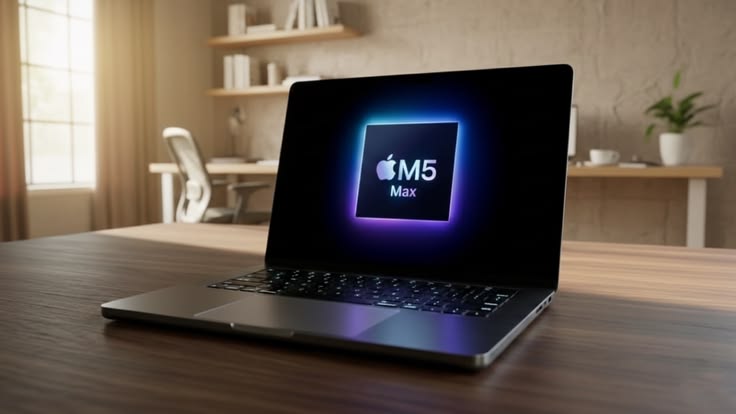
Apple Redefines Pro Performance: MacBook Pro Debuts with M5 Pro and M5 Max Featuring Fusion Architecture
Mar 3, 2026 |
👀 144 views |
💬 0 comments
Apple today unveiled its most powerful laptop lineup to date, introducing the all-new 14-inch and 16-inch MacBook Pro powered by the M5 Pro and M5 Max chips. Built on a revolutionary Fusion Architecture, these machines represent a monumental leap in on-device AI capability, effectively moving the MacBook Pro from a "creative workstation" to a "frontier AI development lab."The announcement comes just months after the base M5 chip debuted, signaling a rapid acceleration in Apple’s silicon release cycle to meet the surging demand for local AI processing.1. The "Fusion Architecture" BreakthroughFor the first time in Apple Silicon history, the Pro and Max variants utilize an advanced dual-die bonding technique.The Single-SoC Advantage: By connecting two high-speed dies into a single System on a Chip (SoC), Apple has eliminated the latency bottlenecks typically found in multi-chip architectures.Super Cores: The new 18-core CPU architecture introduces "super cores"—Apple's fastest CPU cores to date—alongside 12 next-generation performance cores. This results in a 30% boost in multithreaded performance over the M4 generation.Massive Bandwidth: The M5 Max supports up to 128GB of unified memory with a staggering 614GB/s bandwidth, crucial for loading massive Large Language Models (LLMs) into VRAM for instant inference.2. Next-Level On-Device AI: The Neural AcceleratorApple has re-engineered the GPU to act as a secondary AI engine, supplementing the dedicated 16-core Neural Engine.Neural Accelerators in Every Core: Each GPU core now features a dedicated Neural Accelerator. This dual-threat approach delivers over 4x the peak AI compute performance compared to the previous generation.LLM Benchmarks: Apple claims the M5 Max can process LLM prompts up to 6.7x faster than the M1 Max, allowing developers to run models like Llama 4 or Claude 3.5 Sonnet locally with near-zero latency.Generative Creative Tools: In apps like DaVinci Resolve and Topaz Video, AI-powered effects rendering is now up to 3x faster than the M4 Max.3. Pro Storage and Connectivity "N1"The "Pro" experience has been upgraded beyond just the processor, addressing long-standing requests for faster data handling.Blazing SSD Speeds: New storage controllers deliver up to 14.5GB/s read/write speeds (2x faster than last year), making the opening of 8K RAW video files feel instantaneous.N1 Wireless Chip: The MacBook Pro is the first Mac to feature the Apple N1 chip, bringing Wi-Fi 7 and Bluetooth 6 support for more stable, high-bandwidth wireless connections in crowded professional environments.Thunderbolt 5 for All: Every port on the M5 Pro and Max models is a dedicated Thunderbolt 5 port, allowing for up to 120Gbps of data transfer and the ability to drive up to four external 6K displays.4. macOS Tahoe: The Intelligence OSLaunching alongside the hardware, macOS Tahoe is deeply optimized for the M5 series' unique architecture.Live Translation 2.0: System-wide, zero-latency voice and text translation that works even when completely offline.Enhanced Spotlight: A new multimodal search that can find specific moments in your video library or images based on complex natural language queries (e.g., "Find the clip where the cat jumps over the blue fence").5. Pricing and AvailabilityApple has adjusted the entry-level configurations, notably doubling the starting storage for all pro models.14-inch MacBook Pro (M5 Pro): Starts at $2,199 (Now with 1TB standard).16-inch MacBook Pro (M5 Max): Starts at $3,599 (Now with 2TB standard).The "Base" 14-inch (M5): Now starts at $1,699 with 1TB of storage.Executive Quote: "MacBook Pro with M5 Pro and M5 Max isn't just a spec bump; it’s a re-imagining of what a professional can do without a cloud connection. By putting Neural Accelerators in every GPU core, we are giving every developer the power of a server rack in their backpack." — Johny Srouji, SVP of Hardware Technologies
🧠 Related Posts
💬 Leave a Comment