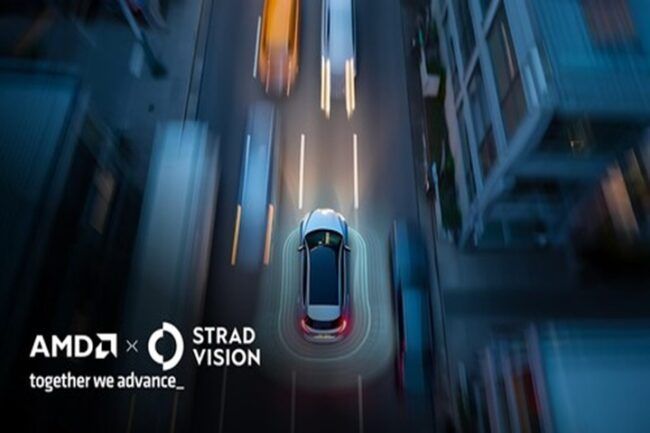
STRADVISION and AMD Reveal Single-Chip Multi-Camera Perception Breakthrough at CES 2026
Jan 4, 2026 |
👀 170 views |
💬 0 comments
In a major step toward affordable autonomous driving, STRADVISION, a leader in deep learning-based vision perception, and semiconductor giant AMD have unveiled a new collaboration at CES 2026 that allows a single chip to "see" everything around a vehicle simultaneously.
The demonstration, running on the new AMD Versal™ AI Edge Series Gen 2 adaptive SoC (System on Chip), showcases STRADVISION’s SVNet MultiVision software processing multiple camera feeds at once—a critical requirement for next-generation self-driving cars.
The "One Brain, Many Eyes" Solution
The partnership addresses a critical bottleneck in the automotive industry: the need to process massive amounts of visual data from cameras all around the car (front, rear, side, and surround-view) without filling the trunk with expensive computers.
The Hardware: The demo utilizes AMD's Versal™ AI Edge Series Gen 2, a powerful adaptive chip designed specifically for the rigorous demands of automotive AI. It features specialized "AI Engines" (AIE-ML v2) that handle complex calculations with high efficiency.
The Software: STRADVISION’s SVNet acts as the visual cortex, taking raw video feeds and instantly identifying other cars, pedestrians, lanes, and free space. The "MultiVision" capability means it does this for the entire 360-degree environment in real-time.
The Result: A scalable system that allows automakers to upgrade from basic Level 2 driver assistance (like lane keeping) to Level 3 autonomy (hands-off driving) using the same efficient architecture.
Why It Matters: The "Centralized" Shift
Automakers are racing to move away from scattered "black boxes" (where one chip handles parking, another handles cruise control) to centralized architectures where fewer, more powerful chips handle everything.
Cost & Space: By consolidating these functions onto a single AMD chip, manufacturers can reduce cabling, weight, and complexity.
Flexibility: The "adaptive" nature of the AMD chip means the system can be updated or reconfigured even after the car is sold, a key feature for modern Software-Defined Vehicles (SDVs).
"This collaboration tackles a critical industry challenge: transitioning from Level 2 assistance to Level 3 autonomy without redesigning vehicle architectures," noted a spokesperson at the event. The demonstration is currently live at the AMD booth in the Las Vegas Convention Center, West Hall.
🧠 Related Posts
💬 Leave a Comment