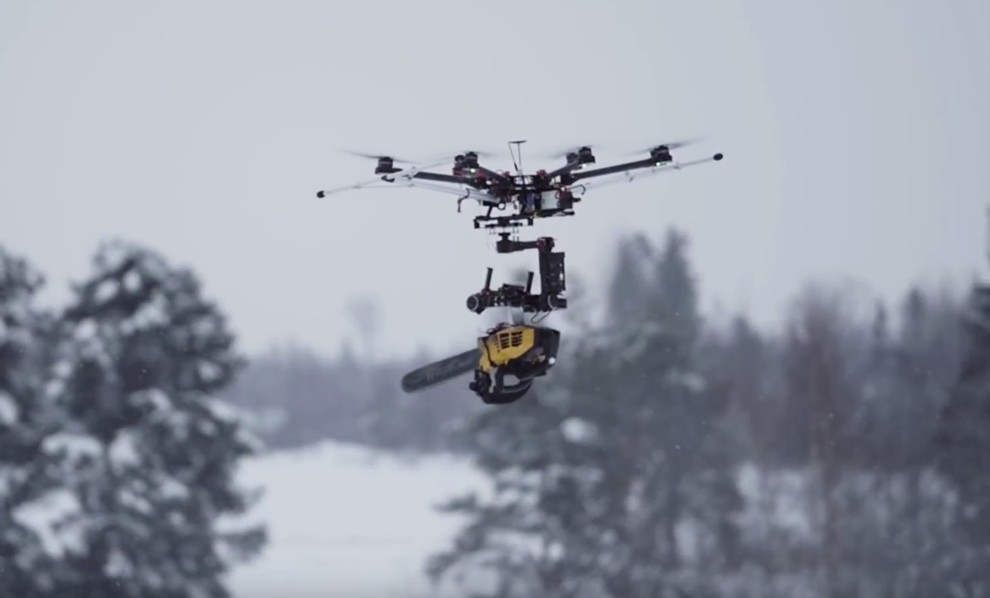
Cutting-edge safety: Kiwi team builds AI chainsaw drone
Jan 4, 2026 |
👀 180 views |
💬 0 comments
In a move that blends forestry with futuristic robotics, a team of New Zealand researchers has developed an AI-powered drone equipped with a chainsaw, designed to take humans out of one of the world's most dangerous jobs.
The project, led by Professor Richard Green and Dr. Sam Schofield at the University of Canterbury (UC), has successfully demonstrated a drone capable of autonomously identifying, clamping, and sawing through tree branches. The technology promises to revolutionize how power lines are cleared and forests are managed, eliminating the need for workers to dangle from helicopters or climb precarious ladders.
"Lumberjack in the Sky"
While the concept of a "flying chainsaw" might sound like a horror movie trope, the engineering behind it is a sophisticated feat of safety and precision.
The Tech: The drone utilizes advanced computer vision and AI to "see" the branch it needs to cut. Unlike a human operator who might struggle with depth perception from the ground, the drone’s onboard systems calculate distance, wind speed, and branch movement in real-time.
The Mechanism: Once the target is identified, the drone flies into position and uses a specialized clamping mechanism to lock onto the branch. This stabilization is crucial; without it, the force of the saw would send the drone spinning out of control. It can currently slice through branches up to 60mm (2.4 inches) in diameter.
Why It Matters: Saving Lives
Forestry and line maintenance are notoriously hazardous industries. The primary goal of the "Kiwi chainsaw drone" is to remove humans from the "at-height" risk equation entirely.
Power Line Safety: Trimming vegetation near high-voltage lines usually requires live-line arborists to work in high-risk zones. This drone allows crews to stay safely on the ground while the robot handles the "hot work."
Commercialization: Backed by a $10 million grant from the Ministry of Business, Innovation and Employment (MBIE), the team is preparing the technology for commercial release in late 2026. Industry partners in the electricity and civil construction sectors are already lining up to deploy the tool.
overcoming the "Wobble"
Professor Green noted that the hardest part wasn't attaching the saw, but teaching the drone to fly while using it. "Flying drones in windy conditions next to trees required a lot of artificial intelligence navigational algorithm work," Green explained. The team had to solve complex aerodynamic challenges to ensure the drone didn't clip its own propellers on leaves or get knocked off course by the recoil of the saw.
The successful prototype marks a significant victory for New Zealand's "agri-tech" sector, proving that when it comes to dangerous outdoor work, the best man for the job might actually be a machine.
🧠 Related Posts
💬 Leave a Comment