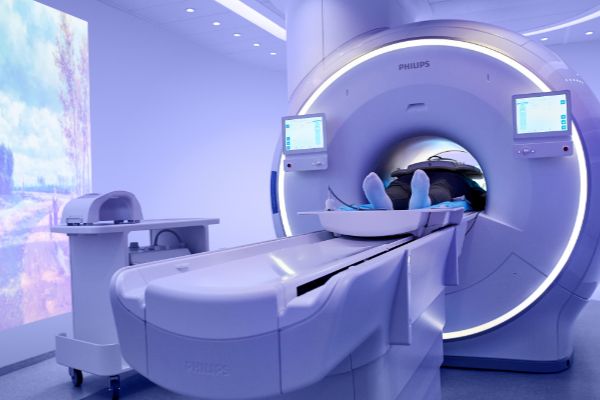
Bedside Breakthrough: AI Brings MRI-Precision to Every Clinic
Jan 16, 2026 |
👀 200 views |
💬 0 comments
In a historic shift for medical diagnostics, the era of the "bulky, million-dollar MRI suite" is being challenged by a wave of AI-driven bedside tools. As of January 16, 2026, new clinical data and regulatory shifts have confirmed that portable, ultra-low-field (ULF) imaging—once considered "grainy" and experimental—has finally reached the precision threshold required for routine clinical use.
The breakthrough is being led by a cohort of "software-defined" imaging companies, most notably Hyperfine (Swoop) and Ventripoint Diagnostics, who are using generative AI to "reconstruct" high-resolution data from low-power hardware.
The "Swoop" Revolution: Clinical & Economic Validation
On January 6, 2026, Hyperfine, Inc. announced the first peer-reviewed publication in Clinical Neuroimaging proving the massive economic impact of its Swoop AI-powered portable MRI.
The "Time-to-Diagnosis" Leap: A 12-month study at Jefferson Abington Hospital revealed that using portable MRI in the ICU and Emergency Department reduced MRI wait times by an average of 18 hours.
Cost Avoidance: The system eliminated the need to transition critically ill patients to "MR-compatible" transport equipment, saving hospitals an average of $590 per patient in specialized tubing and electrodes alone.
The "Contrast" Frontier: Just yesterday (January 15), Hyperfine enrolled its first patient in a landmark Contrast PMR study. This aims to allow portable MRI to use gadolinium-based contrast agents, potentially unlocking the ability to monitor brain tumors and MS lesions at the bedside for the first time.
Beyond the Brain: Heart Assessments with MRI Accuracy
While Hyperfine dominates neuroimaging, Ventripoint Diagnostics is applying similar logic to the human heart.
The "VMS+" Breakthrough: Ventripoint’s AI-driven system takes standard 2D ultrasound images—which are cheap and portable—and uses a massive database of MRI scans to reconstruct them into 3D volumetric models.
MRI Results, Ultrasound Price: The result is heart-mapping accuracy that matches the "gold standard" of MRI, but can be performed in a local clinic in minutes. Following a surge in investor interest this week, the company is scaling manufacturing to meet a 2026 global rollout.
AI: The Bridge from "Low-Field" to "High-Precision"
The technical secret behind this "bedside breakthrough" is Deep Learning Image Reconstruction (DLIR).
Training on the Giants: Companies like GE HealthCare and Hyperfine have trained their AI models on millions of high-field (3T and 7T) MRI scans.
The "Upscaling" Effect: When the portable 0.064T (low-field) scanner takes a blurry image, the AI "understands" what the underlying anatomy should look like based on its high-field training, effectively filling in the gaps to produce a diagnostic-quality image.
New Sequences: Last month, the FDA cleared a new "Diffusion-Weighted Imaging" (DWI) software for portable systems, which allows doctors to detect acute strokes with nearly the same sensitivity as a multi-million dollar stationary unit.
The "ACCESS" Catalyst: July 2026
The final piece of the puzzle is a major shift in how the U.S. government pays for healthcare.
CMS ACCESS Model: Launching in July 2026, the Centers for Medicare & Medicaid Services (CMS) will introduce "outcome-aligned" payments.
Efficiency Rewards: Instead of paying per test, the government will reward clinics that achieve faster diagnoses and better outcomes. This creates a massive financial incentive for clinics to adopt portable AI imaging, which slashes facility overhead and accelerates patient throughput.
"We are moving from an era of bulky hardware to agile, software-defined intelligence," said a market analyst at Equity-Insider. "In 2026, the 'load-bearing walls' of a hospital are no longer made of concrete—they're made of AI."
🧠 Related Posts
💬 Leave a Comment