AI Boosts Lung Cancer Detection Sensitivity by 24% Without Increasing False Positives
Jan 30, 2026 |
👀 102 views |
💬 0 comments
A landmark study published today in the Journal of the American College of Radiology reveals that artificial intelligence has officially crossed the threshold from "experimental tool" to "essential partner" in the fight against lung cancer.
The research, led by Dr. Jamie Schroeder of Georgetown University Medical Center, proves that AI assistance significantly improves a radiologist's ability to identify early-stage lung cancer on low-dose CT (LDCT) scans—the "gold standard" for screening—while simultaneously speeding up the diagnostic process.
1. The Georgetown Breakthrough: Precision at Speed
The study evaluated 16 radiologists as they interpreted 340 complex CT scans. The results provide some of the strongest evidence to date for the integration of AI into clinical workflows:
Sensitivity Surge: AI assistance increased radiologist sensitivity for identifying early lung cancer by 24.3%.
The "False Positive" Myth: Critically, this spike in detection did not come at the cost of accuracy. Specificity remained stable, meaning the AI helped doctors find more cancer without causing an influx of "false alarms" or unnecessary biopsies.
Time Efficiency: Mean interpretation time per scan dropped from 133 seconds to 115.9 seconds—a 12.9% reduction in workload that could help clear massive screening backlogs worldwide.
Detection AUC: The "Area Under the Curve" (a measure of overall diagnostic accuracy) jumped from 0.65 to 0.76 when AI was utilized.
2. NHS Launches "AI + Robotics" Trailblazer
Coinciding with the U.S. study, NHS England launched a first-of-its-kind pilot program on January 27, 2026, at Guy’s and St Thomas’ NHS Foundation Trust. This initiative combines AI screening with robotic intervention to tackle the hardest-to-reach cancers.
The 6mm Target: Using AI software (Optellum’s Virtual Nodule Clinic), the system flags nodules as small as 6mm—the size of a grain of rice.
Robotic Precision: Once the AI identifies a high-risk nodule deep in the lung, a robotic camera guides biopsy tools through the airways with sub-millimeter precision, reaching spots previously considered "too risky" to sample.
Faster Answers: The pilot aims to replace weeks of "wait and watch" repeat scans with a single, 30-minute procedure.
3. Solving the "Workload Crisis"
As lung cancer screening programs expand globally, the volume of CT scans is overwhelming the existing radiologist workforce. Recent 2025 and 2026 data highlight AI’s role as a "force multiplier":
Workload Reduction: A 2025 study from the University of Liverpool demonstrated that AI can accurately rule out "negative" scans with such high confidence that it could reduce a radiologist's reading burden by up to 79%.
Reducing Anxiety: In September 2025, Radboud University researchers showed that AI reduced "false positive" results by 40%. This is a major win for patient mental health, as it prevents thousands of people from experiencing the "diagnostic limbo" of suspicious-but-benign findings.
4. The Future: The "AI Cockpit"
By late 2026, the industry is moving toward a "Comprehensive AI Cockpit." Instead of separate tools for different tasks, radiologists will use a unified dashboard where every incoming CT scan is automatically:
Prioritized (Triage: high-risk cases move to the top of the pile).
Pre-Measured (AI calculates nodule volume and growth rates).
Risk-Stratified (AI assigns a malignancy probability score based on the patient's EHR and scan patterns).
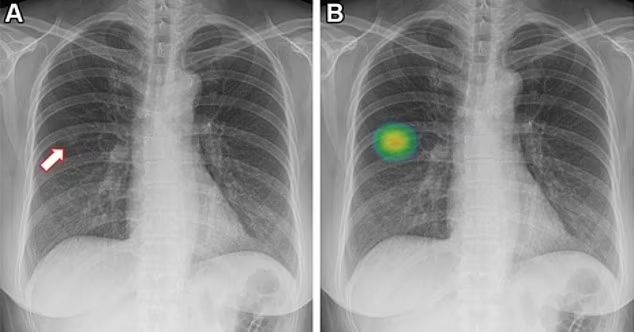
Expert Quote: "We are moving from a world where we look for a 'needle in a haystack' to a world where the AI highlights the needle in neon green," says Dr. Anne Rigg, Medical Director at Guy’s and St Thomas’. "This isn't about replacing doctors; it's about giving them the superpower of perfect recall and infinite focus."
🧠 Related Posts
💬 Leave a Comment